
In a market environment where most digital assets are tethered to the whims of Federal Reserve commentary and macroeconomic indicators, an outlier always warrants a closer look. Over the past several weeks, Zcash (ZEC) has become that outlier. While Bitcoin struggles to hold its 200-day moving average, Zcash has staged a rally that can only be described as parabolic, surging from roughly $50 in mid-September to prices that have flirted with—and at times, surpassed—$400. The price action alone is remarkable, a near 8x return in under two months.
But the price is a lagging indicator. It’s the result, not the cause. The more compelling story lies in the data preceding and accompanying this move. This isn't just another speculative fever dream fueled by anonymous social media accounts. My analysis suggests this is a direct market reaction to a series of deliberate, technically-focused moves by the Electric Coin Co. (ECC), the entity behind Zcash. The market isn't just buying a ticker; it's buying a renewed, and suddenly more accessible, thesis for financial privacy.
The Engineering Preceding the Economics
To understand the Zcash crypto surge, you have to look past the charts and examine the engineering commits and strategic decisions made in late Q3. The narrative began to shift on August 28th, when ECC rolled out a decentralized off-ramp for shielded ZEC. It accelerated on October 1st with the release of a decentralized on-ramp, dubbed "Swaps." Critically, in the process, ECC temporarily disabled the convenient Coinbase on-ramp, citing a new session-token requirement from the exchange that it deemed incompatible with its core privacy principles.
This was a fundamentally anti-commercial decision. They chose principle over convenience, a rarity in any industry. This action, combined with the new decentralized rails, sent a clear signal: Zcash was re-centering itself not as a speculative asset, but as a functional tool for privacy.
The market’s response was not immediate, but it was decisive. The flow of capital into Zcash’s most private protocol, Orchard, began to climb. As of the latest data, the shielded supply in the Orchard pool has surpassed 4.1 million ZEC. This isn't just traders buying `ZEC Zcash` on an exchange; this is capital actively being moved into the protocol's shielded sanctuary. The growth in shielded supply since mid-September accounts for the vast majority of the recent increase. People aren't just holding it; they're using it as intended.
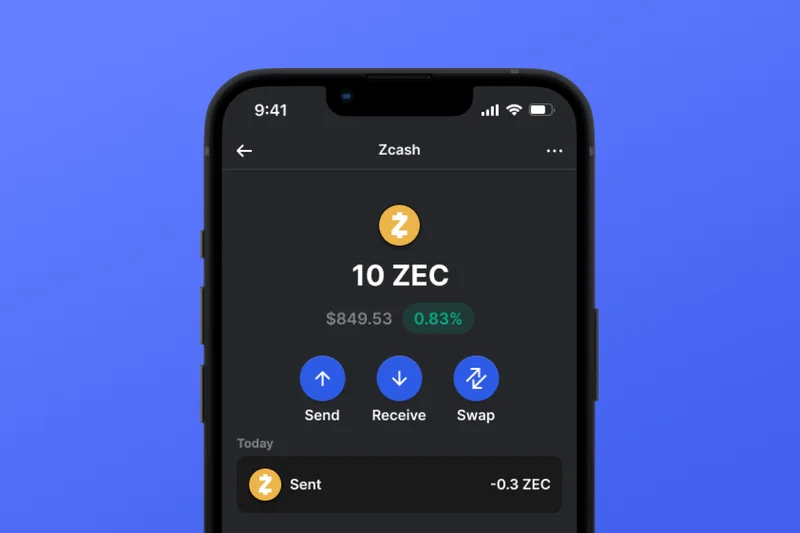
ECC's newly unveiled Q4 2025 roadmap is an explicit doubling-down on this strategy. The plan isn't filled with vague promises of ecosystem growth or metaverse partnerships. It’s a dry, technical list focused on hardening the user experience: ephemeral addresses for every swap, automatic generation of new transparent addresses after use, and improved hardware wallet support. It’s the equivalent of a bank announcing it’s upgrading its vault doors and shredders instead of redesigning its lobby. It’s not flashy, but it’s precisely what reinforces the core value proposition. I’ve looked at hundreds of corporate roadmaps, and this is the part of the announcement (Zcash creator ECC unveils Q4 2025 roadmap as privacy token's price and shielded supply surge) that I find genuinely telling—it's all substance, no fluff.
A Clear Divergence in Market Narratives
What makes the `Zcash price` action so significant is its divergence from the rest of the market, particularly Bitcoin. The current `Bitcoin price` is a reflection of institutional sentiment, ETF flows, and Powell's every utterance. BTC has become a macro asset. Zcash, on the other hand, is demonstrating a dynamic driven by its own internal ecosystem. The chatter on platforms like Reddit and Twitter isn't about when the Fed will pivot; it's about the "cypherpunk" ethos and the renewed importance of privacy in an increasingly transparent financial world.
This has manifested in a significant re-shuffling within the privacy coin sector itself. For years, Monero has been the undisputed leader in market capitalization. In this recent surge, Zcash’s market cap flipped Monero’s. This isn't just new money entering the privacy space; it's capital making a specific choice. Why? One could argue that Zcash, with its optional transparency and support from major regulated exchanges like `Coinbase`, presents a more viable long-term path for privacy. It offers an "on-ramp" to privacy that is palatable to the existing financial system, a feature Monero, by its very design, cannot.
The Zcash `Zashi wallet` improvements are a core component of this. Privacy is a feature, but usability is what turns a feature into a product. By focusing on the user flow—decentralized swaps, hardware wallet integration, and minimizing address reuse—ECC is solving the last-mile problem for privacy protocols. What is the point of a shielded pool if getting funds in and out is a high-friction, high-risk endeavor?
Of course, we must acknowledge the gaps in the data. It's difficult to ascertain with certainty what percentage of the shielded supply growth comes from new capital versus existing holders simply moving their funds from transparent addresses into the Orchard pool. The effect on `Zcash price prediction` models is significant either way (one signals new demand, the other signals increased conviction from existing holders), but the distinction is important for a complete analysis. The total value locked in the shielded pool is impressive—somewhere around $1.7 billion, to be more exact, over $1.72 billion at recent highs—but its composition remains opaque by design.
A Flight to Functional Privacy
This entire episode is less a story about the `Zcash coin price` and more a case study in market incentives. For years, the crypto market has rewarded hype, vaporware, and promises of future utility. The Zcash rally is a powerful, data-backed counter-narrative. It demonstrates that there is a deep and underserved demand for projects that focus on executing their core mission with technical excellence. ECC's decision to prioritize privacy-enhancing engineering over easy exchange liquidity was a gamble, and the numbers show it's paying off. The market is rewarding substance. The question now is whether this is a temporary rotation back to crypto's roots or the beginning of a sustained trend where functional, usable privacy commands a lasting monetary premium.