When a $106 Million Loss Is the Only Thing That Matters
For most of 2025, QuantumScape’s stock price seemed to operate on a different plane of physics than the rest of the market. Propelled by a narrative of game-changing battery technology, the stock (NYSE: QS) executed a near-vertical climb, surging roughly 180% year-to-date. It was a classic story stock, fueled by tangible, impressive milestones: a public demonstration of its solid-state battery powering a Ducati motorcycle, a manufacturing process breakthrough codenamed “Cobra” that promised a 25x increase in output, and a string of blue-chip partnerships with materials giants Corning and Murata. Each piece of `qs stock news` acted as another stage booster on a rocket already heading for the moon.
The market’s logic was clear. For years, the primary criticism of QuantumScape was that its technology was a "science project," confined to the lab. The Ducati demo in September, which showcased an 844 Wh/L energy density and a 10-80% charge in just 12 minutes, was the company’s direct rebuttal. The Corning and Murata deals were the follow-up, a powerful signal that the company was pivoting from pure R&D to industrial-scale manufacturing. Is QS Stock the Future of EV Batteries? Inside QuantumScape’s Game-Changing Deal with Corning Investors responded in kind; the Corning announcement alone sent the stock soaring 15% in a morning session. Trading volumes spiked, and retail sentiment, a qualitative but potent force, was overwhelmingly bullish. The company, it seemed, was systematically de-risking its path to commercialization, and the market was rewarding it handsomely. Then came October 22nd.
The Gravity of a Balance Sheet
Ahead of its Q3 earnings report, the stock began to wobble, culminating in a sharp intraday plunge of about 12%—to be more exact, 12.5% to close at $13.58 after the numbers were released. The sell-off erased nearly $2 billion in market capitalization. The catalyst wasn't a failed battery test or a canceled partnership. It was something far more mundane, yet infinitely more powerful in the short term: a balance sheet.
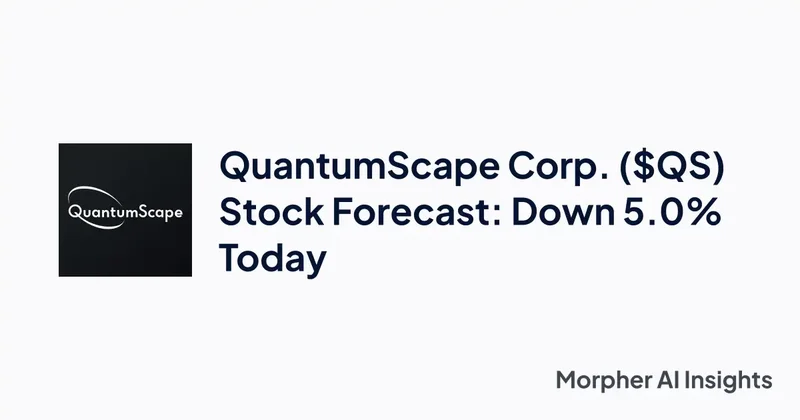
QuantumScape reported a Q3 net loss of $105.8 million. QuantumScape(QS) Stock: Tumble 12% as Q3 Loss and R&D Spend Pressure Financials Total operating expenses hit $114.9 million, with the lion’s share, a full $92.1 million, poured into research and development. This is the central paradox of QuantumScape. The very R&D spending that produces the headline-grabbing breakthroughs is also the source of the immense cash burn that spooks investors. While the company proudly sits on a formidable $1 billion in liquidity—a runway that management claims extends through 2030—the quarterly numbers served as a stark, clinical reminder that the finish line is still years away. I've looked at hundreds of these pre-revenue tech filings, and the disconnect between the operational progress narrative and the sheer scale of the cash burn here is unusually stark. It creates a valuation paradox where good news on the technical front directly contributes to bad news on the financial one.
This isn't a phenomenon unique to QuantumScape; it's the same dynamic that has defined the valuations of companies from `Tesla stock` (TSLA) in its early days to countless biotech firms. But the market’s reaction to QS’s Q3 report highlights a crucial shift in sentiment. The narrative is no longer enough. Investors, having priced in the promise of the technology, are now beginning to price in the cost and the time required to deliver it. The company’s own data reveals this tension. While the Ducati demo was a success, management also noted that B-sample prototypes—the versions closer to commercial units—are targeted for 2024-25, with a full commercial launch still pegged for around 2027. That’s a long time to be burning through nearly $100 million a quarter.
The data from Wall Street analysts and company insiders only reinforces this sober assessment. The consensus analyst price target for `QS stock price` sits in the $5-$7 range, implying a staggering 50-60% downside from its post-earnings price. This isn't just conservative modeling; it's a fundamental disagreement with the market’s narrative-driven valuation. More telling, perhaps, is the insider activity. Company filings show that insiders sold over 2.3 million shares in the preceding quarter. While there are many reasons for insiders to sell, the sheer volume during a parabolic stock run suggests that those with the most information see the wisdom in de-risking their personal holdings at these valuations. (The company did lower its full-year capital expenditure guidance to a leaner $30–$40 million, a minor concession to efficiency, but it hardly changes the overall picture). When the people building the rocket start selling their seats, it’s worth paying attention.
The Price of a Promise
Ultimately, the 12.5% drop wasn't irrational, nor was it a verdict on QuantumScape’s technology. It was a repricing of time. The market is beginning to understand that the path from a successful prototype to a gigafactory-scale production line is not a straight line; it's a long, winding, and incredibly expensive road. The Corning and Murata partnerships are critical signposts on that road, but they don't generate revenue today. For all the excitement, QuantumScape remains a pre-revenue company valued at nearly $9 billion. Its stock is not a reflection of its current business, but a bet on a future one. The Q3 report simply reminded everyone just how far away, and how costly, that future still is.