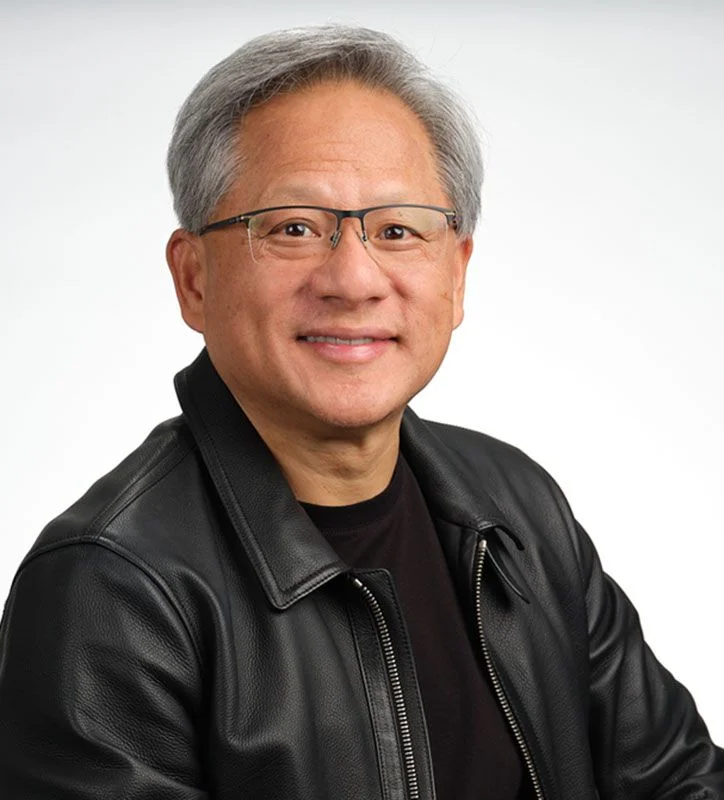
It’s not often the CEO of a company touching a $4 trillion market capitalization spends his airtime praising a sanctioned, state-backed competitor. Yet, that’s precisely what Jensen Huang did. Standing under the bright lights of a media interview, the ever-present leather jacket a stark contrast to the clinical precision of his words, Nvidia’s chief executive delivered a message that was, on its surface, a warning about Huawei.
But when you parse the language, analyze the context, and trace the flow of capital and silicon, it becomes clear this wasn't just a simple hat-tip to a rival. It was a masterclass in strategic communication, aimed not at Wall Street, but squarely at Washington D.C.
Huang’s core statement was direct (Nvidia CEO Jensen Huang sends stern ‘Huawei’ warning: ‘It is foolish to…’): “It is foolish to underestimate the might of China and the incredible, competitive spirit of Huawei.” He didn’t stop there. He offered specific, unsolicited praise for their technical prowess, noting their dominance in 5G, their "amazing chips," and their large-scale AI supercomputing system (CloudMatrix). I've reviewed hundreds of CEO transcripts in my career, and this level of granular, laudatory detail about a direct competitor—one currently in the crosshairs of US national security policy—is a significant outlier. It’s not the kind of thing you say by accident.
The immediate question is, why? Why would the leader of a company that he himself claims is “miles ahead” in the AI race dedicate so much oxygen to inflating the reputation of its most formidable geopolitical challenger? The standard interpretation is that he’s simply keeping his team on their toes, a classic management tactic to prevent complacency. But that feels too simple, too pedestrian for a game being played at this level. The reality, my analysis suggests, is far more complex.
The Art of Framing a Foregone Conclusion
The most revealing part of Huang’s commentary wasn’t the praise for Huawei, but his assessment of the Chinese market’s appetite for American technology. “China makes plenty of AI chips themselves,” he told CNBC, before delivering the critical line: “China doesn’t want H20 or any American chips.”
Let’s deconstruct that statement. It’s presented as a matter of preference, of market choice. But is it? The United States government has explicitly banned the export of Nvidia’s most powerful chips to China. The H20, a less-powerful chip Nvidia designed specifically to comply with those export controls, has reportedly seen sluggish demand. So, is China rejecting American chips out of a nationalistic desire for self-sufficiency, or are they simply refusing the watered-down versions they’re being offered while accelerating development on their own unrestricted hardware?
Huang is framing a geopolitical necessity as a market dynamic. It's an elegant sleight of hand. By saying "China doesn't want" our products, he subtly shifts the narrative away from "China can't have" our best products. This serves a crucial purpose. It implies that the export controls, while perhaps well-intentioned, are ultimately pushing China to become a fully independent and even more dangerous competitor faster than they otherwise would have. It’s a message packaged for policymakers: your restrictions are not crippling our rival; they are forcing them to build their own vertically integrated ecosystem, a fortress of silicon that will be completely immune to American policy in the future.
This is where the numbers come into play. Huang dangled the size of the prize: a market opportunity in China of "probably $50 billion this year," growing to potentially "a couple of 100 billion dollars by the end of the decade." The discrepancy between that enormous potential and the current reality of US restrictions is the silent subtext of his entire monologue. He’s not just talking about Huawei; he’s talking about hundreds of billions of dollars in revenue that are being legislated off the table.
A Signal to Two Audiences
This entire performance is a high-wire act of dual messaging. To his internal teams and the market, the message is clear: "We respect the competition... that’s why we run so fast." It’s a justification for Nvidia’s relentless R&D spending and its aggressive innovation cycle. Hyping up a boogeyman, especially one as credible as Huawei, is an effective way to keep an organization galvanized.
But the more important message, the one delivered between the lines, is for the regulators and politicians crafting US trade policy. By portraying Huawei as an indomitable force and Chinese self-sufficiency as an inevitability, Huang is making a nuanced, almost fatalistic argument. What is he really asking? Is he suggesting that further tightening of sanctions is futile and will only accelerate the rise of a competitor that America can’t control? Or is he perhaps lobbying for a more strategic approach, one where the U.S. allows the sale of some advanced technology to keep China partially dependent on the American ecosystem, rather than forcing a complete and hostile decoupling?
The logic is almost a form of game theory. If your opponent is determined to build their own weapons, is it better to cut off their supply of basic materials entirely, knowing they will eventually succeed and you'll have no insight or leverage? Or is it better to sell them some components, creating a dependency that gives you a measure of control and market access? Huang seems to be subtly advocating for the latter. His statements paint a picture of an unstoppable force, implying that the most rational response is not to build a higher wall, but to find a more intelligent way to engage with the reality of their power. It's a deeply pragmatic, if politically controversial, position.
This Isn't a Warning; It's an Argument
Let's be perfectly clear. Jensen Huang’s commentary on Huawei was not a simple act of professional courtesy or a motivational speech for his employees. It was a calculated piece of geopolitical theater. He used the platform to construct a specific narrative for a specific audience: Washington. By elevating Huawei’s capabilities and framing China's move toward technological independence as a deliberate choice rather than a forced reaction, he is subtly critiquing the long-term effectiveness of America's current export control strategy. He is sending a signal that the policy of total denial is creating a more formidable, more resilient, and ultimately more dangerous competitor in the long run. This wasn't a warning about Huawei; it was an argument about American policy, delivered by the one man who stands at the absolute center of the silicon universe.