
[Generated Title]: 3I/Atlas: Alien Spaceship or Just Another Space Rock? NASA's Data Dump Doesn't Settle the Debate
Okay, so NASA dropped the 3I/Atlas data. The question everyone's been whispering is: alien probe or just a comet doing a drive-by? The agency's been quick to say it's "just a comet." But let's dig into the numbers and see if that holds water.
The Interstellar Visitor: A Statistical Anomaly?
First, the facts. 3I/Atlas is only the third interstellar object confirmed to visit our solar system. That's three out of billions, maybe trillions, of objects out there. Even with improving detection technology, that's a minuscule sample size. NASA's acting astrophysics director, Shawn Domagal-Goldman, said, "Everyone that is in control of a telescope wants to look at it because it’s a fascinating and rare opportunity." Rare is the operative word here. Is it statistically improbable enough to warrant a closer look at alternative explanations?
The size estimates are all over the place – from 1,444 feet to 3.5 miles across. That’s a huge discrepancy. (Why such a wide range? What are the error bars on those measurements?) This lack of precise data fuels speculation. If we can't even nail down the size, how confident can we be about its composition and origin?
NASA officials were quick to shut down the “alien ship” theories, attributing the delay in releasing data to the government shutdown. Amit Kshatriya stated, "3I/Atlas is a comet." But I've looked at enough corporate statements to know that what they don't say is often more telling. They addressed the alien ship theories but didn't offer a detailed rebuttal based on the comet's observed characteristics. Why not?
Planetary Defense and the Art of Trajectory Prediction
One interesting angle is the use of 3I/Atlas for planetary defense research. The European Space Agency (ESA) used observations from Mars orbiters to refine the comet’s trajectory. They claim the Martian observations improved the predicted location by a factor of 10. That’s significant. But how much does a factor of 10 actually reduce the uncertainty in a real-world asteroid impact scenario? What’s the delta in calculated risk? Spacecraft at Mars have spotted comet 3I/ATLAS. What they saw could help save our planet
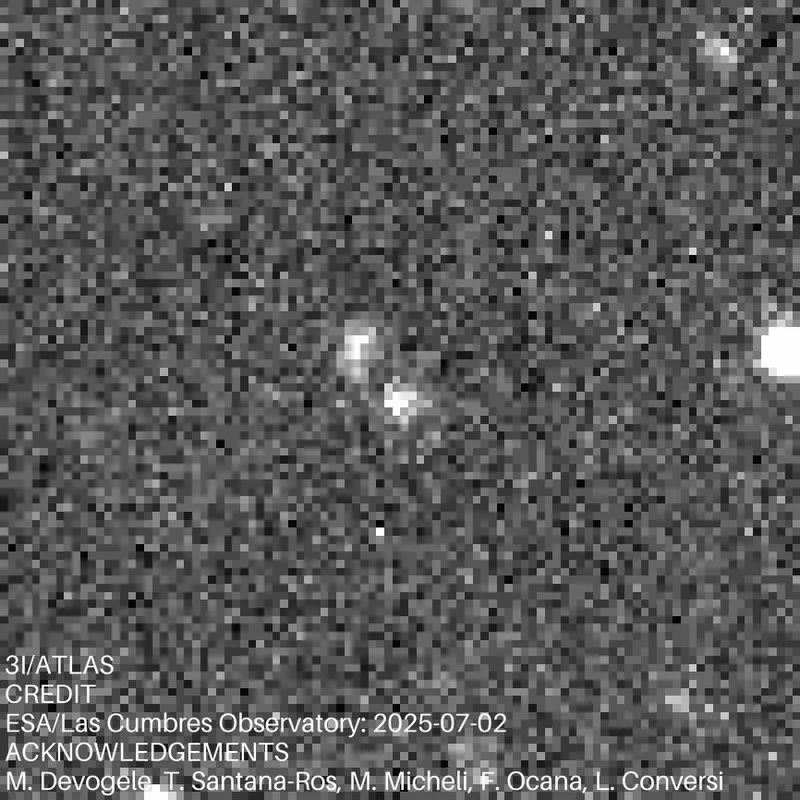
The comet is moving at roughly 150,000 mph. That's not unusual for a comet, but it does mean trajectory calculations need to be incredibly precise. The ESA had to account for the fact that the observations were made by a spacecraft orbiting Mars at speed. Usually, they are working with observatories on Earth, or sometimes a space telescope orbiting Earth. (That's a pretty big difference in the math.)
NASA's Planetary Defense Officer, Kelly Fast, expects to see "upward trends" in the discovery of interstellar objects. This raises a question: are we simply getting better at spotting them, or is there an actual increase in interstellar traffic? And if there is an increase, what's causing it? Are we approaching some kind of interstellar "highway"?
And this is the part of the data that I find genuinely puzzling. NASA works with the Pentagon’s All-domain Anomaly Resolution Office (AARO), formerly known as the UFO group, on these kinds of things. But AARO wasn't involved in the 3I/Atlas assessment because it was "assessed to be a comet." But who made that initial assessment, and what data did they use? It feels circular – it's a comet because we've decided it's a comet.
Nicky Fox, NASA’s Associate Administrator of the Science Mission Directorate, said that "It could be from something that existed before our own solar system — that is so cool. It’s from something that predates even our own star." Cool, sure. But also potentially something else. The focus on the age of the comet seems like a distraction.
The Jury's Still Out
The "official" story is that 3I/Atlas is a comet, period. But the data, or the lack of definitive data, leaves room for doubt. The fact that NASA felt the need to explicitly deny the alien ship theory, coupled with the AARO's non-involvement, raises more questions than answers.
Occam's Razor or Conveniently Simple?
While the simplest explanation is often the right one, sometimes the simplest explanation is just the one we want to be true. The data on 3I/Atlas doesn't definitively prove anything, but it certainly doesn't close the door on the possibility that there's more to this interstellar visitor than meets the eye.